The National Folklore Survey for England home page
We will continue to signpost the activities of the NFS here on the CCL site however the NFS site will be the main vehicle for sharing information and events related to the survey.
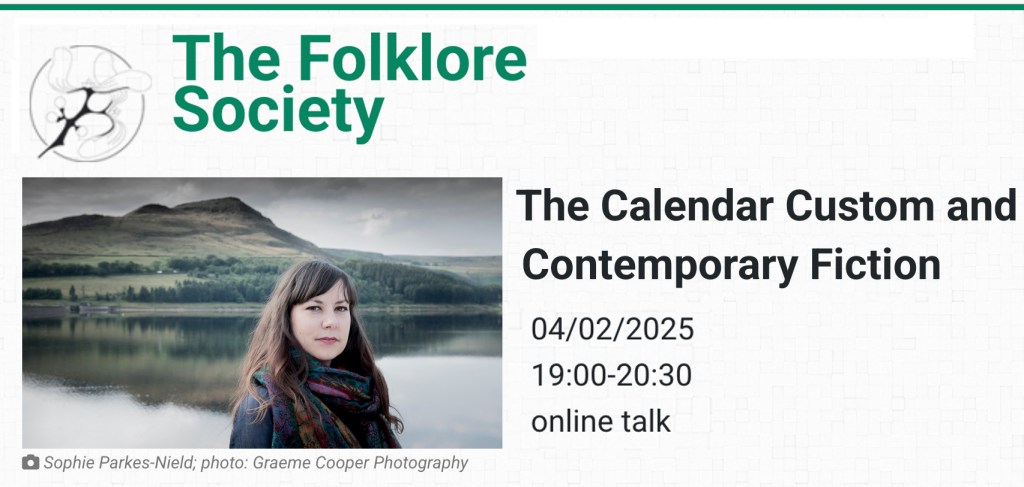
How could, or even should, a writer approach intangible cultural heritage such as the calendar custom in their creative work?
This talk was based on Sophie Parkes-Nield’s doctoral research that examines the role and impact of the calendar custom in contemporary fiction. Sophie appraised a wide range of examples of contemporary fiction in which a calendar custom is represented, and reflected on her own practice of writing a novel in which a calendar custom is situated at its heart.
We are delighted to welcome Dr Sophie Parkes-Nield as our new Postdoctoral Researcher on the National Folklore Survey project.
Dr Sophie Parkes-Nield along with some of her folklore related publications.
Sophie recently gained her doctorate from Sheffield Hallam University in creative writing and folklore exploring how contemporary novels and novelists represent the calendar custom in England. We caught up with her to learn more about her research and interests.
Hello Sophie! We’re looking forward to working with you. What was it about the National Folklore Survey project that inspired you to apply?
I finished my PhD in September and was teaching a course for short fiction publisher, Comma Press, on ‘writing fiction with folklore’. The National Folklore Survey project sounded perfect as it allows me to combine my fascination for English folklore and specifically calendar customs, with the skills I had honed in marketing and communications during the fifteen years prior to my return to full-time academia in 2019. It’s the perfect time to conduct a survey such as this, it’s much needed, and I feel so lucky to be able to work on it.
Why do you think a survey is ‘much needed’?
Folklore seems to be everywhere at the moment: on the television, in films and novel; folklore-based podcasts are exploding. Most excitingly, to my mind, artists and practitioners are looking at how or what aspects of folklore are being used, and whose folklore is being included and excluded. Yet we don’t have a sound idea of how folklore resonates with people living in England today, we don’t know what ‘folklore’ means to them. What excites me about this project is the potential for a dataset that can be used as a benchmark, or a marker for beliefs and behaviours, that we can share with anyone – with everyone!
When did you become interested in folklore?
I first ‘discovered’ English folk and traditional music when I was a teenager, and as my love for the music grew, I began to take more of an interest in folklore and the wider folk arts. I grew up in North Oxfordshire where there is a strong, proud Cotswold morris dancing tradition which I slowly learnt to love – much to the bemusement of my friends and family – but I have only very recently become a morris dancer myself, albeit in the North West tradition, where I now live. Folklore is such a vast subject which is – obviously and necessarily – continually evolving and mutating, and I am constantly reminded how little I know. I’m hoping immersing myself in the National Folklore Survey will remedy that!
Finally, what aspect of the project are you most looking forward to?
It sounds strange, but I’m really looking forward to testing the survey with focus groups. I love that moment in a focus group – or any kind of discussion group – when your perception shifts and you see something in a wholly different way, that gives your project or idea a whole new thread or angle. It always leads to more work, of course, but it’ll be for the better.
Thanks, Sophie!
If you would like to know more about Sophie, her research and her writing, you can visit her websiteHERE.
We are excited to share our final schedule for the coming week’s ISCLR Conference. In addition to 13 themed panels and 33 presentations the conference includes a ghost walk around Sheffield City and Cathedral; a performance by the Grenoside Sword Dancers; a showing of folklore related films by SHU Illustration students; a conference banquet: and a day trip to the Peak District including a visit to Peak Cavern (The Devils Arse) in Castleton and a guided tour of Eyam.
Please find below a pdf showing a breakdown of the panel topics – a pdf of abstracts will be shared soon.
We’re pleased to open registration for the 40th International Perspectives on Contemporary Legend Conference, held this year June 26-30, 2023 at Sheffield Hallam University, South Yorkshire, UK, and hosted by the Centre for Contemporary Legend.
There will be a series of themed panels including:
Body Horror
Social Media
Furries and Ghosts
Politics, fake news, rumour
Conspiracy & Belief
Nation & Indigienous legend
Haunted Houses
Digital Legends
Monsters
X-Files and UFOs
Crime & Moral Panics
The conference includes an optional ‘Legend and Landscape‘ excursion to the Peak District National Park, with a guided visit to the Plague VIllage of Eyam (see HERE) and a tour of Peak Cavern in Castleton (see HERE).
There will also be a conference meal at the Showroom Cinema and an evening event (watch out for further details!)
This year, ISCLR is pleased to extend members-only registration rates for members of The Folklore Society (FLS).
We have a hotel booking tool with special conference rates for two hotels in Sheffield: the Leonardo Hotel Sheffield and the Novotel Sheffield Centre. Book HERE
If you would like to join ISCLR please use this online form HERE
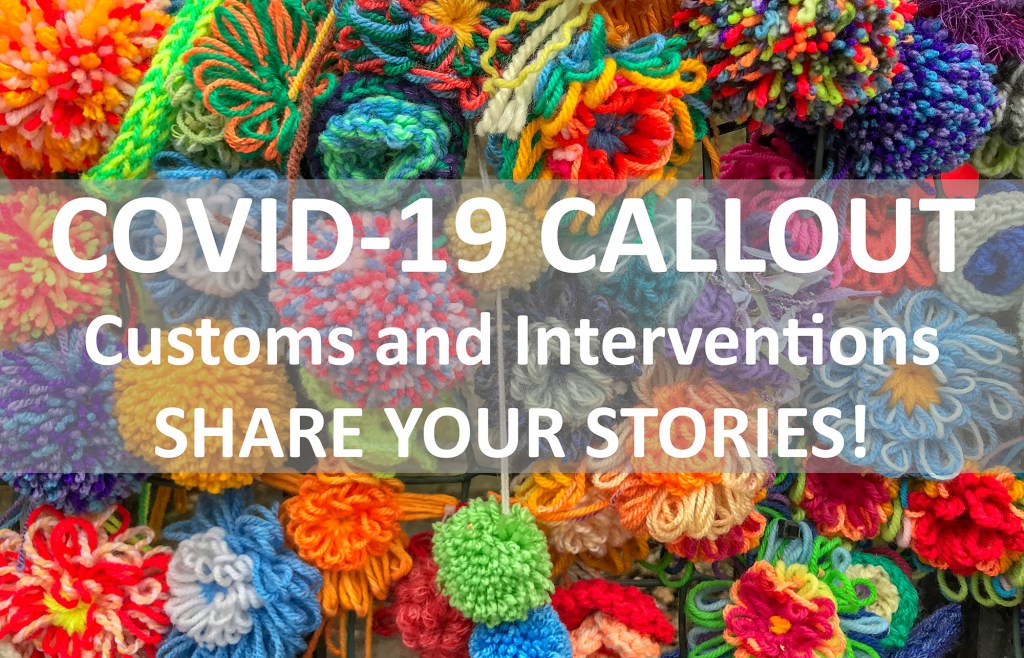
Background image – Covid Pom-Pom display on church gate, Baildon, West Yorkshire.
Here at the Centre for Contemporary Legend at Sheffield Hallam University we have been collecting examples of responses to Covid-19 in the form of new customs, interventions and displays from scarecrows, rainbows, stone snakes and curbside gifts to communal responses such as the Belper Moo. We are also interested in how traditional calendar customs have adapted to the lockdown and the limitations imposed by the pandemic, often taking their activities online.
You can find some of the responses we’ve documented further down this blog and CCL members David Clarke and Andrew Robinson discuss their interest (along with the Belper Moo if you’ve not heard of it before!) in the Podcast they produced for the Festival of The Mind also detailed below.
We would very much like anyone who has an interesting story about ‘Covid Customs and Interventions’ they are willing to share to contribute it to our collection, along with any imagery they are happy to provide. All contributions will be fully credited (if desired) and the results shared with all contributors.
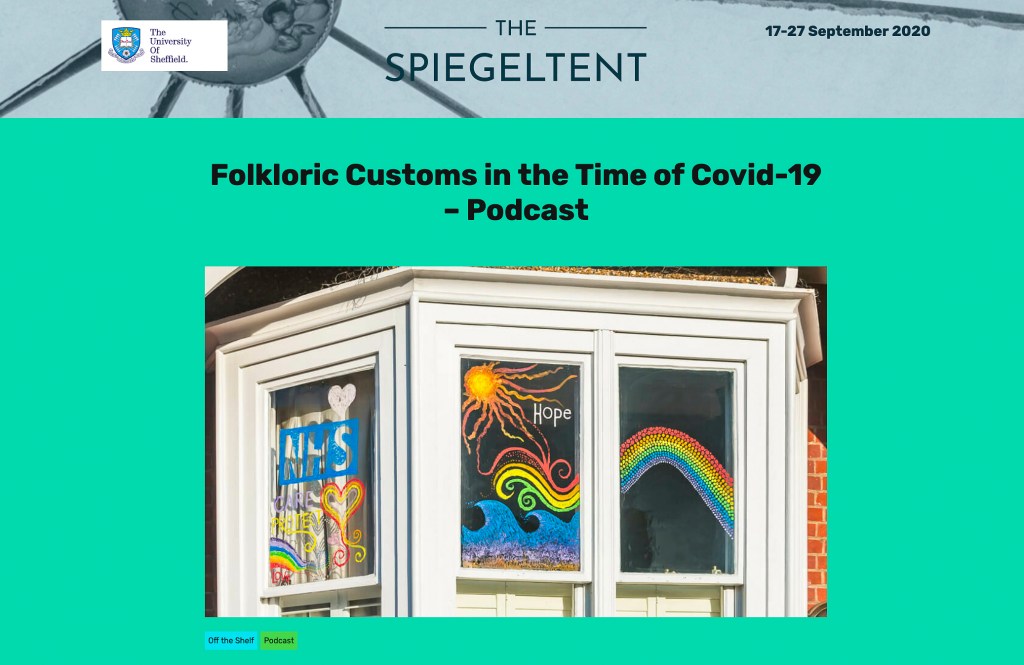
“Dr David Clarke and Andrew Robinson explore the new folkloric customs and traditions that have emerged nationally and in the Sheffield / Peak District area as an outcome of the COVID-19 lockdown.” Listen to the Podcast HERE. Part of the 2020 Festival of The Mind (see HERE) and the Off The Shelf Festival of Words (See HERE).
In this podcast Dr David Clarke and Andrew Robinson from the Centre for Contemporary Legend research group at Sheffield Hallam University discuss the new folkloric customs and traditions that have emerged nationally and in the Sheffield/Peak District area in particular, as an outcome of the COVID-19 lockdown. Whilst traditional customs such as the Castleton Garland and numerous well dressings were cancelled, others events were held online and new rituals emerged such as the weekly #ClapForCarers. Rainbow artwork decorated windows, stone snakes appeared in parks and scarecrows in a range of guises popped up in front gardens across the country. David and Andrew reflect on these and other responses to the lockdown as forms of custom and legend in this socially distanced, remotely recorded podcast.
The podcast was written and presented by Dr David Clarke and Andrew Robinson. Andrew recorded and edited the audio and provided field recordings of a number of traditional customs.
A small selection of images of Covid Scarecrows collected by Dr David Clarke during the May Bank Holiday from Stannington on the Western fringe of Sheffield.
“I was out for a walk with my wife in late May in the Loxley Valley and we climbed the hill up towards Stannington and when we reached a back road we saw what appeared to be a person sitting on the top of a high stone wall. We watched as we climbed the hill and I thought this was an unusual person as they hadn’t moved for ages. It was only when we got close I realised that this was actually quite an elaborate decorated scarecrow. Sporting a tartan hat, dark sun glasses, bright red lipstick and fluorescent pink socks, all decked off with a flower garland and a ‘Support the N.H.S.’ rainbow hanging around its neck (see the far left image above). As we walked further into the village and along the main street we saw more and more scarecrows and increasingly elaborate designs and I believe a number of them have been subsequently photographed and featured in the local paper, the Sheffield Star.“
“It’s interesting how these and other scarecrows that appeared during the original lockdown and shortly afterwards have been decorated and the themes that have been used. Alongside the omnipresent rainbows and the showing of support for N.H.S. and care sector workers there has also been the appearance of heroes and villains with Boris Johnson and Dominic Cummings masks appearing on scarecrows alongside representations of Captain Tom Moore the veteran solider who raised millions for the N.H.S. These are all interesting themes that are being played out through these local displays which seek to both provide entertainment but also personal and political commentary during Corvid.”
This commentary is taken from a Podcast entitled: Folkloric Customs in the Time of Covid-19 (available HERE) recorded by CCL’s Dr David Clarke and Andrew Robinson for the 2020 Festival of The Mind (see HERE) and the Off The Shelf Festival of Words (See HERE).
Moving a conference online is no mean feat: will the technology work? Will everyone feel engaged when they can’t make direct eye contact or network over finger food? How will Chairs and Speakers enliven the stilted atmosphere of the online world?
With Earth(ly) Matters 2020, Sheffield Hallam’s Humanities and Social Sciences Society have made it look fiendishly easy. Using the three thematic strands of the conference to organise presentations, Roots, Rebellions and Resolutions, Earth(ly) Matters was split over three Fridays in August to prevent Zoom fatigue and to enable attendance from anyone, anywhere.
The conference explored ‘what matters on Earth and how Earth matters’, taking Amitav Ghosh’s claim, that the current environmental crisis is ‘also a crisis of culture, and thus of imagination’, as provocation. What role, speakers were asked, can the humanities and social sciences play at a time of climate breakdown and a catastrophic decline in wildlife?
On Friday 7 August, under the banner of ‘Roots’, I was fortunate to be able to present my work on calendar customs and their link to the natural environment, exploring whether those involved in such calendar customs could become climate activists on a hyperlocal level. Presenters submitted a ‘verbal’ element (a written paper) and a ‘visual’ element (a recorded presentation with visual stimuli) for publication on the conference website to enable engagement beyond the ten-minute live talk on conference day.
Inspiring change remained at the heart of the day: how our work, actions, thoughts and ideas can contribute to a world where change is underway, and change is desperately needed. But there was also fun to be had. Once the conference came to a close, delegates were invited to try bingo – with a difference. Using the Zoom breakout room facility, we learnt more about the lives and research interests of our fellow delegates by collecting information on bingo cards. Finding someone that shares your preferred type of cooked potato has never been so urgent…
Sophie Parkes
You can visit the Earth(ly) Matters conference website HERE and view Sophie’s presentation of her paper Cheese-rolling, Pace-egging, Soul-caking: Can Calendar Customs Engender Stewardship of our Natural Environment below. Sophie would welcome any feedback you might have – contact her at: sophie@sophieparkes.co.uk
A collection of images of scarecrows on the streets of Calow, Chesterfield photographed by Andrew Rodgers during May 2020. As can be seen from the central image residents were encouraed to create scarecrows to brighten up the streets of Calow and “everyone’s daily walks”.
The majority of Scarecrows feature N.H.S. and healthcare workers of made humorous reference to the pandemic (such as the judo scarecrow preparing to fight the virus), Union Jacks and the flag of St. George were also popular motifs, probably as the festival too place close to V.E. day but also as an expression of national resilience against the virus.
Special thanks to Andrew Rodgers for contributing the photographs and for permission to reproduce them here.





 Centre For Contemporary Legend