Cucklet Delph / Inside Cucklet Church / The Limestone arched entrance to Cucklet Church under pulpit rock
This year on the last Sunday in August, for the first time in many years, Cucklet Delph (top left) was empty. The Plague Sunday service that usually takes place here to commemorate the sacrifice made by the villages of Eyam during the plague of 1665-1666 was cancelled and replaced by an online service due to the 2020 Covid-19 pandemic.
During the worst days of the plague in the spring and summer of 1666 the twenty-seven-year-old village rector, William Mompesson, held outdoor services in Cucklet Delph in order to maintain social distancing amongst his flock and to try to prevent the spread of the disease. Since the bicentenary celebrations in 1866 a yearly service has been held in the Delph following a procession through the village with the Vicar preaching from the raised mound underneath which lies Cucklet Church which can be seen in the above photographs.
Online Plague Sunday Service / Mini Well Dressings Displayed on Carnival Day / Villagers leaving Eyam Hall Courtyard in Fancy Dress
Plague Sunday coincides with the village’s much older Wakes Week which begins with the blessing of the three dressed wells followed by a week of activities culminating with the town carnival the following Saturday. This year most of the celebrations were curtailed due to Covid-19. As well dressing is a communal activity it couldn’t take place as normal so in place of the large well dressings small individual designs were created and displayed in the village close to the plague cottages on Carnival Day (5th September). The carnival itself was cancelled however the Hope Valley jazz band played in a driveway opposite Eyam Hall and local people donned fancy dress and gathered at the mechanic’s institute for a socially distanced drink.
A small selection of images of Covid Scarecrows collected by Dr David Clarke during the May Bank Holiday from Stannington on the Western fringe of Sheffield.
“I was out for a walk with my wife in late May in the Loxley Valley and we climbed the hill up towards Stannington and when we reached a back road we saw what appeared to be a person sitting on the top of a high stone wall. We watched as we climbed the hill and I thought this was an unusual person as they hadn’t moved for ages. It was only when we got close I realised that this was actually quite an elaborate decorated scarecrow. Sporting a tartan hat, dark sun glasses, bright red lipstick and fluorescent pink socks, all decked off with a flower garland and a ‘Support the N.H.S.’ rainbow hanging around its neck (see the far left image above). As we walked further into the village and along the main street we saw more and more scarecrows and increasingly elaborate designs and I believe a number of them have been subsequently photographed and featured in the local paper, the Sheffield Star.“
“It’s interesting how these and other scarecrows that appeared during the original lockdown and shortly afterwards have been decorated and the themes that have been used. Alongside the omnipresent rainbows and the showing of support for N.H.S. and care sector workers there has also been the appearance of heroes and villains with Boris Johnson and Dominic Cummings masks appearing on scarecrows alongside representations of Captain Tom Moore the veteran solider who raised millions for the N.H.S. These are all interesting themes that are being played out through these local displays which seek to both provide entertainment but also personal and political commentary during Corvid.”
This commentary is taken from a Podcast entitled: Folkloric Customs in the Time of Covid-19 (available HERE) recorded by CCL’s Dr David Clarke and Andrew Robinson for the 2020 Festival of The Mind (see HERE) and the Off The Shelf Festival of Words (See HERE).
Moving a conference online is no mean feat: will the technology work? Will everyone feel engaged when they can’t make direct eye contact or network over finger food? How will Chairs and Speakers enliven the stilted atmosphere of the online world?
With Earth(ly) Matters 2020, Sheffield Hallam’s Humanities and Social Sciences Society have made it look fiendishly easy. Using the three thematic strands of the conference to organise presentations, Roots, Rebellions and Resolutions, Earth(ly) Matters was split over three Fridays in August to prevent Zoom fatigue and to enable attendance from anyone, anywhere.
The conference explored ‘what matters on Earth and how Earth matters’, taking Amitav Ghosh’s claim, that the current environmental crisis is ‘also a crisis of culture, and thus of imagination’, as provocation. What role, speakers were asked, can the humanities and social sciences play at a time of climate breakdown and a catastrophic decline in wildlife?
On Friday 7 August, under the banner of ‘Roots’, I was fortunate to be able to present my work on calendar customs and their link to the natural environment, exploring whether those involved in such calendar customs could become climate activists on a hyperlocal level. Presenters submitted a ‘verbal’ element (a written paper) and a ‘visual’ element (a recorded presentation with visual stimuli) for publication on the conference website to enable engagement beyond the ten-minute live talk on conference day.
Inspiring change remained at the heart of the day: how our work, actions, thoughts and ideas can contribute to a world where change is underway, and change is desperately needed. But there was also fun to be had. Once the conference came to a close, delegates were invited to try bingo – with a difference. Using the Zoom breakout room facility, we learnt more about the lives and research interests of our fellow delegates by collecting information on bingo cards. Finding someone that shares your preferred type of cooked potato has never been so urgent…
Sophie Parkes
You can visit the Earth(ly) Matters conference website HERE and view Sophie’s presentation of her paper Cheese-rolling, Pace-egging, Soul-caking: Can Calendar Customs Engender Stewardship of our Natural Environment below. Sophie would welcome any feedback you might have – contact her at: sophie@sophieparkes.co.uk
A collection of images of scarecrows on the streets of Calow, Chesterfield photographed by Andrew Rodgers during May 2020. As can be seen from the central image residents were encouraed to create scarecrows to brighten up the streets of Calow and “everyone’s daily walks”.
The majority of Scarecrows feature N.H.S. and healthcare workers of made humorous reference to the pandemic (such as the judo scarecrow preparing to fight the virus), Union Jacks and the flag of St. George were also popular motifs, probably as the festival too place close to V.E. day but also as an expression of national resilience against the virus.
Special thanks to Andrew Rodgers for contributing the photographs and for permission to reproduce them here.
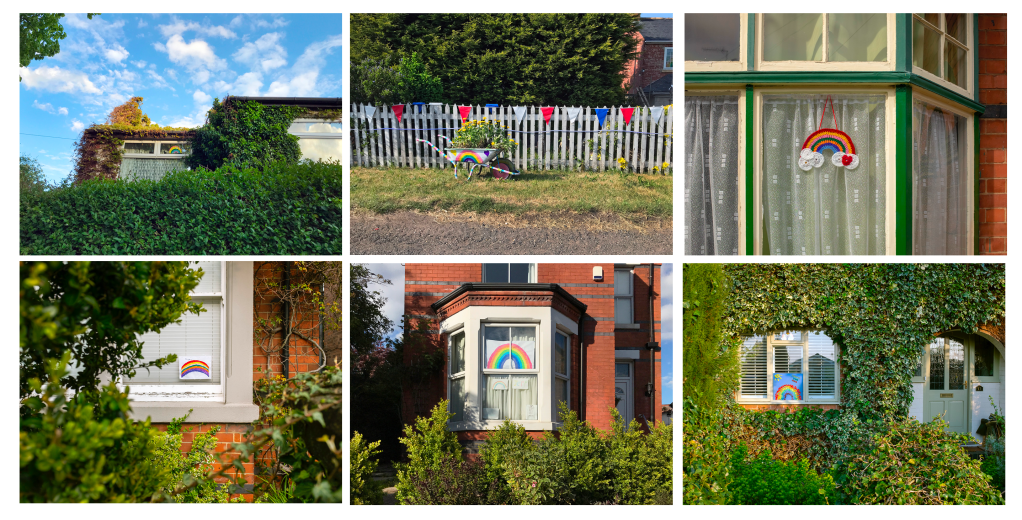
Above are a selection of images of Covid Rainbows collected by Diane A. Rodgers of the Centre for Contemporary Legend during the first lockdown of the Covid-19 pandemic in April 2020 while on daily walks around the Crosspool and Fulwood areas of Sheffield, S10.
An impromptu mini Scarecrow festival was organised by residents of Valley Mews and friends in to give thanks to care workers and entertain children on their daily walks.
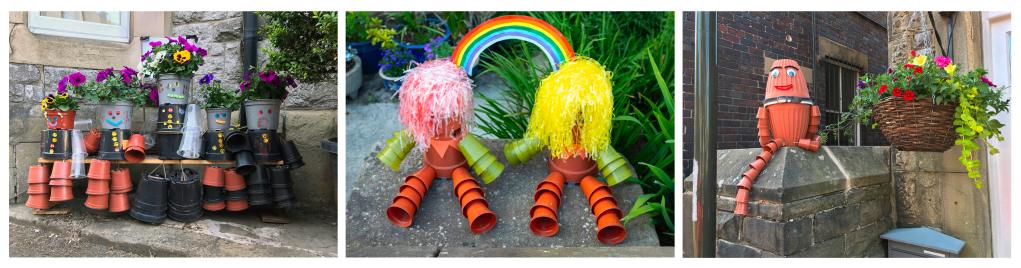
Flower pot figues on display in Buxton, Derbyshire during the Covid-19 lockdown.
by Andrew Robinson
The Covid-19 crisis has resulted in numerous communal and individual responses to the impact of virus and the resulting lockdown across the U.K. that have been widely shared and often copied in both the physical and online worlds.
Many of these activities have developed spontaneously as new customs and rituals, from the communal clapping on Thursday nights, to the display of rainbow drawings and teddy bears in front windows along with displays of scarecrows in gardens and beside roads.
Here at CCL, we are interested in such community responses to the crisis and along with other members of the team I’ve been collecting examples from my local neighbourhood during daily walks a small selection of which I include below.
Rainbows have been seen in many places despite the almost complete absence of any rain for most of lockdown.
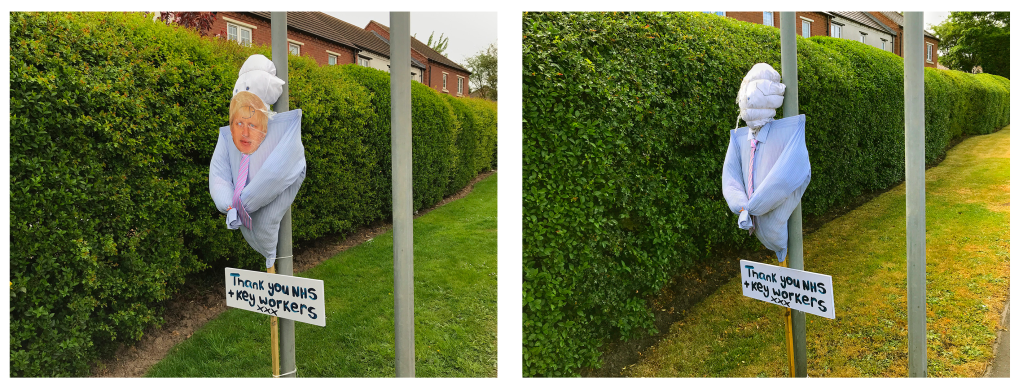
Scarecrows have also been popular in many places – the Scarecrow on the left appeared on a Planes Road on the northern outskirts of Nottingham in early April in support of NHS keyworkers. A week or so after being erected a Boris mask was attached and not long after graffiti was added. Two months later the figure is still present if a little faded and the sans mask.
During May local residents organised a scarecrow festival to give children something to do and to provide something to look at on daily walks. Scarecrows have also been documented by other CLL members in and around Sheffield and the Peak District.
Curb Side Gifts have also been a common sight on streets across the country. A mixture spare time being used to clear out items, and the closure of charity shops and local tips along with far more people walking around the neighbourhood has led to fascinating offerings.
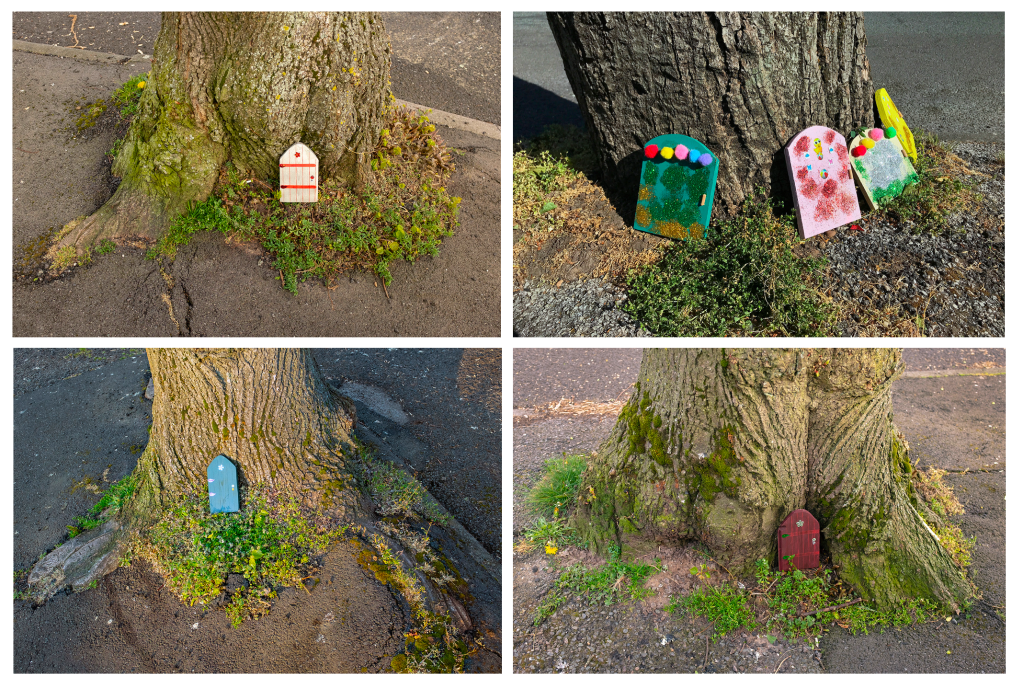
On one street nearby Fairy Doors appeared at the base of every tree and have survived now for nearly two months.
On another street, small inspirational quotes were pinned to every tree.
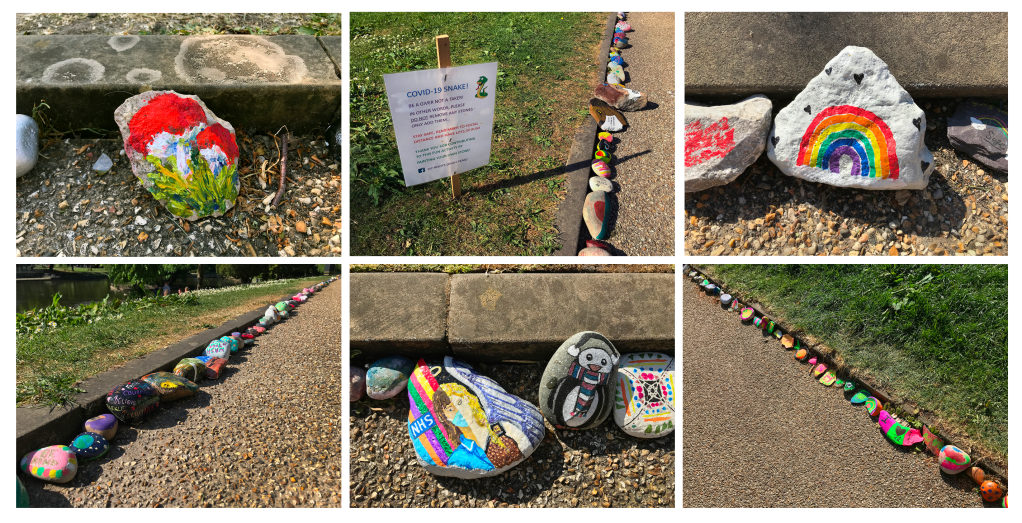
In Buxton, Derbyshire, a ‘Covid-19 Snake’ of painted stones gradually grew along the side of the Pavilion Gardens amassing more than 2000 pebbles. Similar snakes have appeared in other towns.
Whittlesea Straw Bear Festival, 18th and 19th January 2020.
by Sophie Parkes-Nield
The Whittlesea Straw Bear Festival has been on my ‘must-see’ list of calendar customs for years. A towering straw creature paraded through the freezing Fens in early January – what’s not to like? But for my uncle and aunt, who live in a neighbouring village, just outside Peterborough in Cambridgeshire, its presence for the last forty-odd years has barely registered. A friend-of-a-friend was involved they thought; was there some kind of parade? I enticed my uncle to join me on the morning of Saturday 18 January and we set out to find and follow the Bear.
The bright sunshine hadn’t staved off the cold and the fenlands were deserted. But, as soon as we crossed the train line and into the village of Whittlesey (or Whittlesea, in some quarters), there was the familiar tinkle of off-duty morris dancers, their kits concealed by layers, parking cars and weaving through the village centre. By ten o’clock, the marketplace was already full: of parents tired of excitable children, of course, but also by all kinds of other people: young women swaddled in faux fur and posing for selfies, a group of young men in flamingo hats already pouring pints down their necks. I started to tune into the crowds as they awaited the first appearance of the Straw Bear. Another group of twenty-something men – originally local, moved away for university and returned for the festival – were discussing the traits of Whittlesey people on the basis of the tradition before them. ‘As a biologist, I can only say that there must be something genetically different about Whittlesey people.’
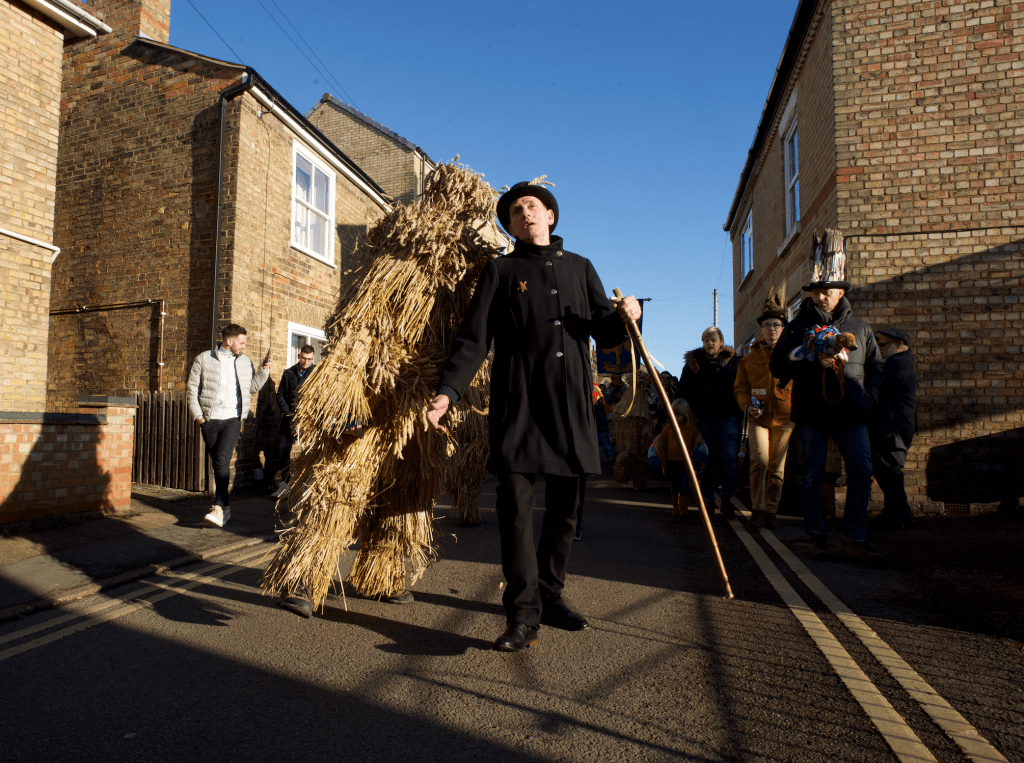
The Straw Bear and his driver lead the procession through the narrow streets of Whittlesea, Cambridgeshire. Photo by Andrew Robinson.
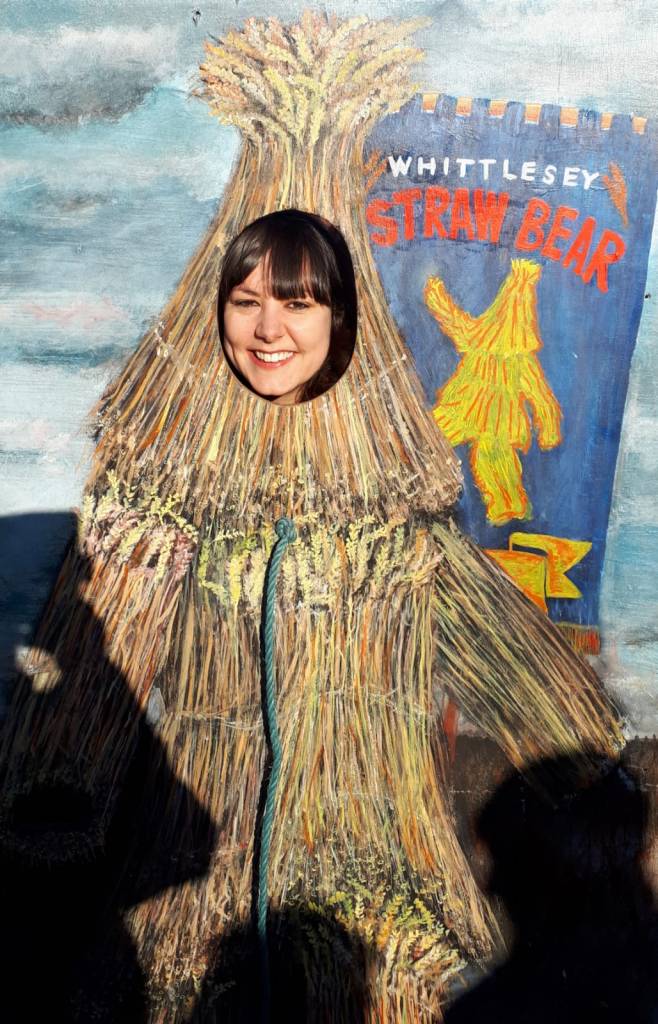
The main event exceeded my expectations. The Straw Bear itself was fleeter of foot, dancing for its keeper in a much nimbler fashion than I thought possible for a human covered in and constricted by straw. Perhaps it wasn’t a human under straw at all; there really was no way of telling. As I lined up to have my photo taken with it, I couldn’t deduce which was the front or back and could barely contain my laughter. A little girl obviously felt the same as me. Waving her Straw Bear flag as excitedly as she inevitably had for Father Christmas only the previous month, she squeaked ‘It’s alive!’ when the Bear lurched towards her.
The procession following the bear was enormous. Folk dance groups made up the bulk of the performers – molly, morris, sword, clog dancers that would later give their own performances at landmark spots around the village – but also schools and other community groups proffered their own songs and tunes, choreography, banners and puppets in honour of the Straw Bear.
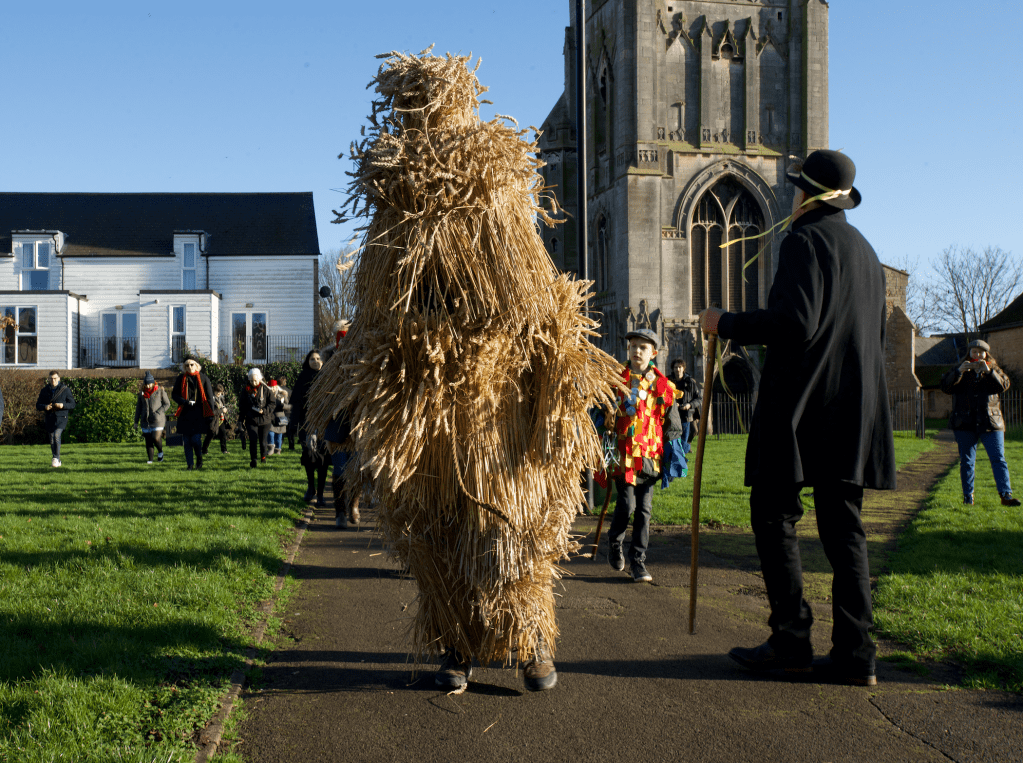
The bear enjoys the freedom to dance offered by the fields surrounding St Mary’s Church, Whittlesea. Photo by Andrew Robinson.
Though I recognised a handful of familiar faces from other events, this appeared to be a genuinely local affair, with performers and spectators from the area gathered together for a variety of reasons: to drink all day in the street with friends, to raise funds for a good cause, to entertain the kids for a few hours, or simply because that’s what’s done in Whittlesey on the Saturday after Plough Monday.
Behind me, a man asked his companion ‘Is this a traditional dance?’ We were watching molly dancers, throwing themselves around a square demarcated by traffic cones and tape. I couldn’t get a good look at them, but I imagined watery, red-rimmed eyes and tweed caps, waxed jackets. ‘I presume so,’ the other man replied in a strained voice. ‘I don’t know the first thing about it.’ And this epitomises my fascination for calendar customs. We turn out to our streets and marketplaces, our fingers turning blue in the cold, often to watch something about which we know relatively little: why it’s performed, for how long the tradition has endured. But we know how it makes us feel here and now. We like to see our neighbours, we like to feel part of something, we like the frivolity of a spectacle that suspends mundanity for a few hours. We like the silliness, the joyousness, the reverence. And when the bunting is taken down and the straw burnt, we like that it will happen again next year.
The Grenoside Primary Team with their wooden swords, Boxing Day, 2019.
by Dr David Clarke and Andrew Robinson
The tradition of long-sword dancing continues in two suburban villages on the outskirts of the City of Sheffield, where the Centre for Contemporary Legend is based. Both are performed annually on Boxing Day, 26 December, at Handsworth and Grenoside and both teams have a busy touring schedule during the year.
The Handsworth team, recorded as early as 1870, were originally based in nearby Woodhouse but moved to Handsworth in 1890 as by that point most of the players, including four brothers from the same family, the Siddles, lived there. Cecil Sharp, founder of the English Folk Dance Society, visited Handsworth twice in 1913 to record the dance, taking notes and photos, which were included in volume 3 of ‘Sword Dances of Northern England’. The dance was traditionally performed throughout the midwinter months however in 1963 boxing day was fixed as a day of dance.
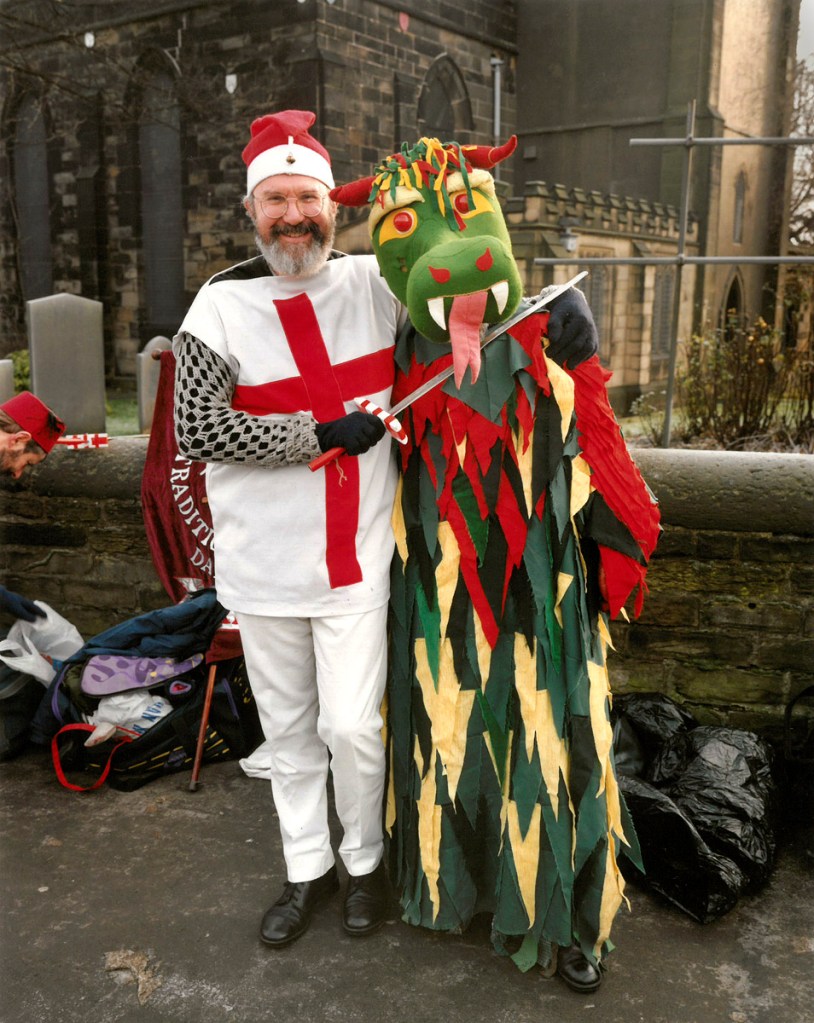
The eight Handsworth Sword dancers wear dragoon-type uniforms and carry steel longswords about a metre in length and perform at two locations each Boxing Day, first in the market square in Woodhouse at approximately 11:15am and then at around midday in front of St. Mary’s Church in Handsworth. Alongside their dance they also perform the ‘Derby Tup’ a mummers play associated with Christmas house visiting customs around Sheffield and South Yorkshire. The ‘Tup’ itself is similar to the Wild Horse of the Antrobus Soul Cakers another winter mummers play (see earlier post) and comprises of a head on a pole with snapping jaws and rams horns with a cloth to cover the performer. The play is accompanied by the singing of the folk song “The Derby Ram” and, also in common with Antrobus, other characters include a driver, Beelzebub, Little Devil Doubt and St George with the addition of a dragon (see below).
St George and the Dragon, St Mary’s Church, Handsworth, Boxing Day, 1997.
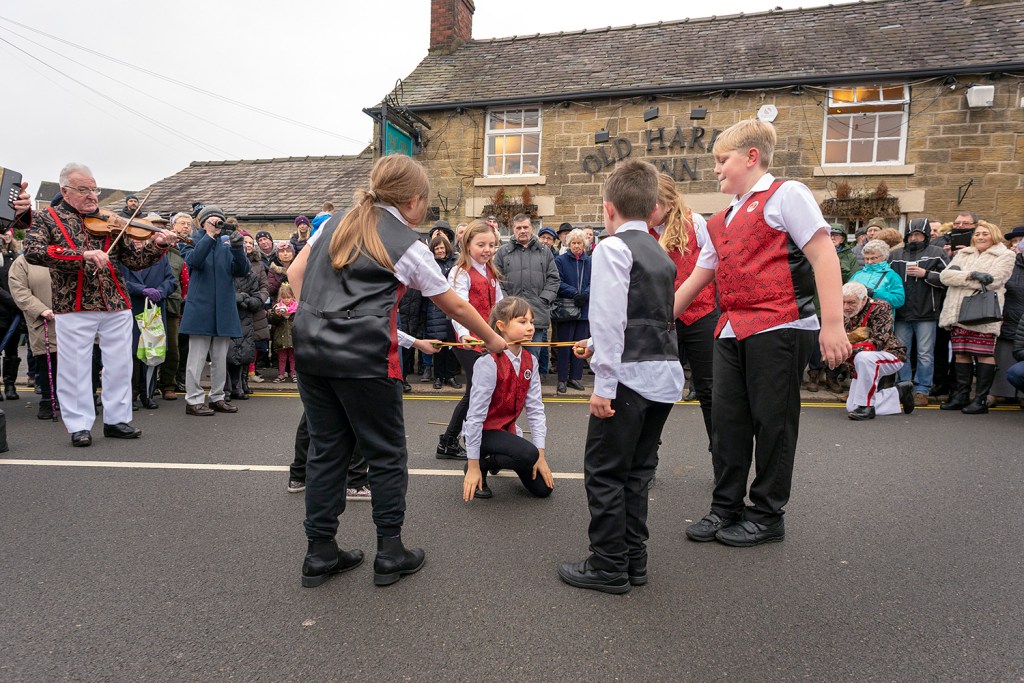
The Grenoside team consists of six dancers and captain who wear military-style uniforms of black caps, black and gold flowered jackets with red stripes, white trousers with red stripes and iron-shod shoes and are accompanied by a fiddler and accordionist. The captain carries a ceremonial edged sword and wears a fur hat which is removed in the ritual ‘beheading’ that takes place during the perfomance. The rhythmically complicated dance in which the circles of swords, held tip to base, remains intact requires a high standard of concentration and skill acquired through frequent practice. Although clogs are not usually part of longsword traditions, at Grenoside they add a rhythmic tramp that adds a certain magic to the performance.
The Captain watches on as the dancers weave in and out of one another without breaking the circle of swords. Grenoside, Boxing Day, 2019.
The Boxing Day performance takes place at 11am outside The Old Harrow Inn on Main Street, Grenoside. Before the First World War the team danced annually on Christmas Eve and Boxing Day and undertook extensive walking tours during the winter period to perform at cottages and larger houses in the surrounding district. An important aspect of the tour was the moeny collected which helped see members over the difficulties of the winter “Short Time” in the local steel and cutlery industries. On one occasion the troupe raised an astonishing £25 from the guests at Earl Fitzwilliam’s Christmas party at Wentworth. The walking tour has recently been revived as an annual ‘traipse’ around Grenoside village, on the first Saturday after the first Sunday in January.
This year the main team was accompanied by the Grenoside Primary team and visiting teams ‘Maltby Phoenix’ and ‘Six Jolly Miners’ along with a clog dance performed by Stephanie Besford. The dances were followed by carol singing in the ‘Top Red’ – the Red Lion public house.
Folklorist Cecil Sharp, who visited Grenoside in 1911 described how “at the climax of the figure they simultaneously and vigorously draw their swords across his neck, there is a grinding clash of steel, and the Lock is disentangled. So realistic is the scene in the actual performance, that when I saw saw it I should not have been surprised if the captain’s head had toppled from his shoulders and rolled to the floor!”
Grenoside Primary Team about to ‘behead’ one of their group, Boxing Day, 2019.
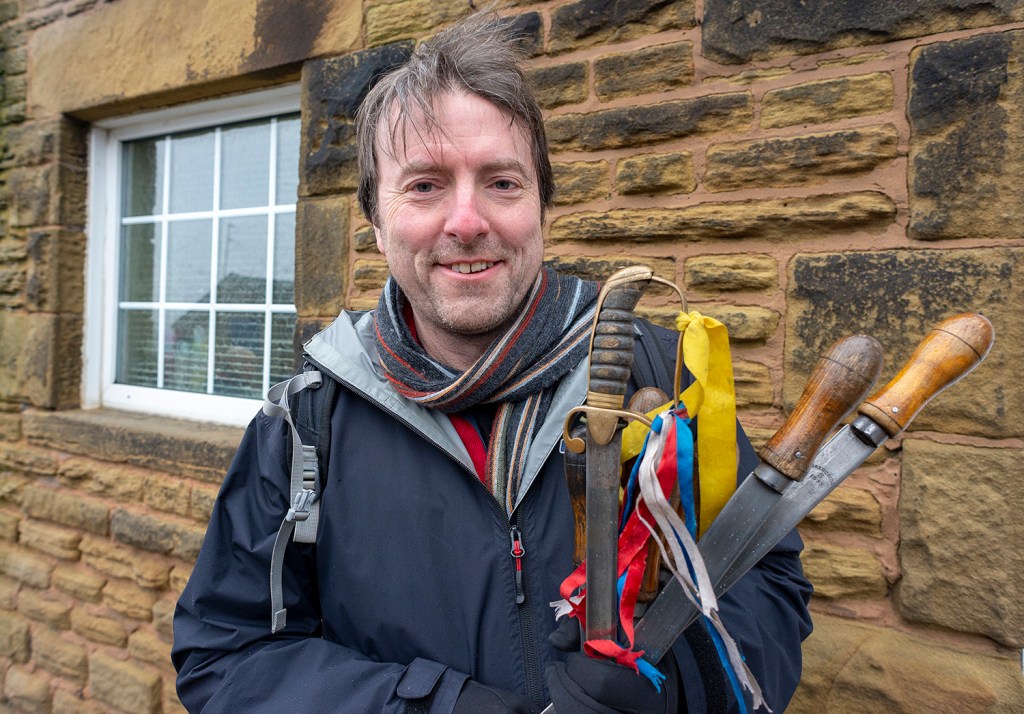
After the dance we were entrusted to guard the swords while the team revived themselves in the Old Harrow before all moved on to the Red Lion for Carols.
CCL’s Dr David Clarke with the Grenoside Swords, Boxing Day, 2019.
CCL co-founder Dr David Clarke presented a paper on the legend of the Cottingley Fairies at the Royal Photographic Society Research Day held at Sheffield Hallam University on the 16th November 2019.
‘Francies and The Faries’ from ‘The Coming of the Fairies’ by Arthur Conan Doyle pub: Hodder & Stoughton Ltd. (1922)
The story of the Cottingley Fairies is one of the greatest photographic mysteries of all time. In the summer of 1917 three images were taken by two young girls using a borrowed camera of tiny fairy creatures playing in and around a small stream in the West Yorkshire village where they lived. When these photographs were added to by two others obtained in 1919, they became the centre of a mystery that lasted more than 60 years, ensnaring many high profile figures who wanted to believe including Sir Arthur Conan Doyle, the creator of the fictional detective Sherlock Holmes who circulated reproduction of the photographs and in 1922 published a book about the mystery entitled ‘The Coming of The Faries’.
The legend of the Cottingley fairies continues to capture the popular imagination today. There have been dozens of books about it, two Hollywood movies and numerous TV programmes and documentaries. Many original documents and photographs are preserved in the Cottingley Fairies Collection at the Brotherton Library, University of Leeds and the National Science and Media Museum in Bradford while other copies occassionally appear at auction and even occassionally on ebay.
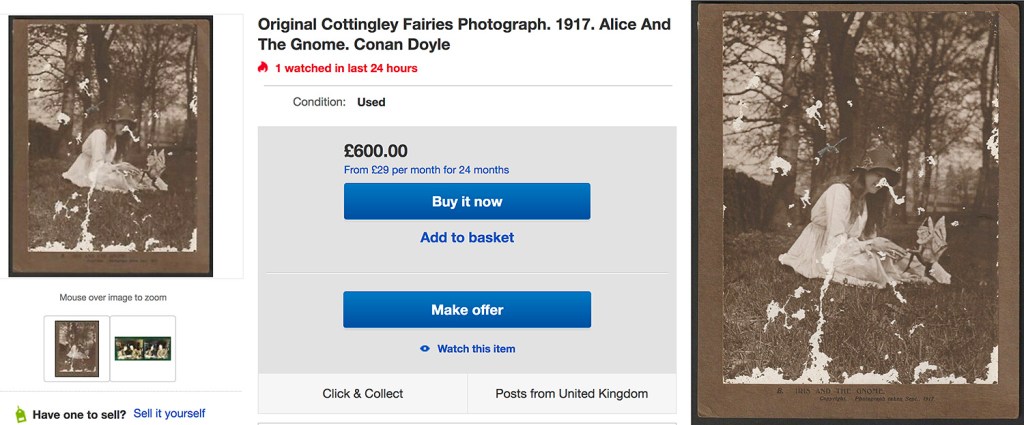
Currently (June 2020) there is a damaged copy titled ‘Alice and the Gnome’ available for £600 on the auction site – shown below and available HERE
“This is one of the original Cottingley Fairies photographs. Less than 6 are known to have survived and they rarely appear at auction. Taken in 1917. The photographs were championed by Sir Arthur Conan Doyle and sold at theosophical society events. Provenance: This copy was given by Conan Doyle to his close personal friend the Reverend George Owen and passed through the family. The photograph has damage as shown in the images, hence the low price. Undamaged examples sell for £5,000 to £6,000 at auction. Please ask any questions.” Item Description from eBay.
Smoke and shredded newspaper drift across the Leon recreation ground in Fenny Stratford as six loud explosions are heard.
by Andrew Robinson
Every St Martins day (11th November) the windows of buildings across Fenny Stratford near Milton Keynes in Buckinghamshire, rattle and shake while animals scurry for cover as six loud explosions ring out across the town marking the annual firing of the Fenny Poppers.
The Poppers are six miniature cannons in the shape of a tankard, possibly repurposed chambers for breach loading cannons, that are fired in succession at 12 o’clock, 2 o’clock and 4 o’clock in memory of the benefactor of the local church, Browne Willis. The event is organised and maintained by a small informal group of people most of whom are associated with the church and has been led for the last 30 years or more by Peter White. This small English custom, which currently attracts only a handful of people, has a continuous history dating back at least 279 years and follows a well-established procedure.
The poppers are first removed from storage in the church where they are permanently on display. Helpers and interested visitors gather in the nearby cemetery close to the entrance to the recreation ground where the custodian Peter White lays out a selection of materials on the path including newspapers, wood and coal for the brazier, hammers, wooden sticks and gunpowder. The poppers are then brought to the footpath and arranged in order by the numbers on their base. Small wooden pegs are then waxed and inserted in the firing holes before gunpowder is poured into the barrels from six small canisters containing the correct measure for each popper.
Compressing newspaper wadding to seal the poppers on the churchyard path.
Peter then hammers numerous sheets of newspaper into the barrels as wadding until each Popper is filled to half an inch from the top. Friends, spectators and passers by, pause to talk and often to help with the packing of the Poppers. Past participants are remembered and regular attendees catch up on recent news and renew acquaintances. Community news is shared as the Poppers are prepared.
During the preparation Peter likes to explain the history of the tradition in conversation with those present, despite most being familiar with the event. Often visitors are invited to fire a Popper and all who do receive a certificate. Occasionally a Popper is dedicated to an individual, usually someone who has recently passed away.
This process takes upwards of 30 minutes as each cannon is packed with newspaper.
The poppers are then carried the short distance to the recreation ground where small depressions in the earth are created for the cannons to rest in approximately 6 feet apart. A small rest, similar to a fishing rest, is placed behind each Popper before the wooden peg is removed from each in turn and a little powder is added to the firing hole.
Peter adds a small amount of pyrodex after removing the wooden pegs in the poppers prior to firing.
At the allotted time, a long, red hot poker is removed from a nearby brazier and carefully carried in turn to each of the chosen firers by a helper. The firer places the poker on the rest and lowers it until the end touches the firing powder. The charge is ignited, there is a bright flash followed by a very loud bang as the cannon is discharged and a shower of shredded paper and smoke drift across the recreation ground. After all six Poppers have been fired the poker is returned to the brazier. The newspaper which has been blown from the cannons is collected and thrown on the fire and the Poppers are carried back to the car in the graveyard. The firing is over within a couple of minutes and the spectators and organisers disperse to return in just over an hour later to repeat the procedure.
The hot poker is slowly lowered onto the popper leading to a sudden flash followed by a loud explosion and clouds of smoke.
The sequence of events takes approximately 45 minutes in total and was inherited by the current master of ceremonies when he took over some 30 years ago and modified over the years for reasons of safety and practicality. Whilst currently attended by only a small audience of approximately 20 people, the six explosions are heard across the community and the event is often covered by the local press and sometimes the national media.
This year I was lucky enough to be invited to fire one of the poppers and received a certificate to prove it. The experience didn’t last long but my ears are still ringing now!
A special thanks to Peter White for his hospitality and help.












 Centre For Contemporary Legend