Review: Invasion of the Saucer Men – The Visual Folklore of UFOs, UAPs & Flying Saucers
Sheffield Creative Industries Institute Gallery, Head Post Office Gallery 11/03 to 02/04 2026
Curated by: Andrew Robinson (SCII)
The exhibition Invasion of the Saucer Men occupies a curious and productive territory between nostalgia, folklore and technological speculation. At first glance, Andrew Robinson’s work appears playful—almost whimsical—drawing heavily on the visual language of mid-twentieth-century British illustration and popular science fiction. Yet beneath this playful surface lies a more serious enquiry into photography, belief, and the evolving relationship between images and truth in the age of artificial intelligence.
Robinson begins from a historically grounded observation: photographs have long been treated as the most persuasive form of evidence in UFO sightings. As the exhibition text notes, witnesses—from civilians to police and military personnel—have relied on photographs to substantiate claims of extraordinary encounters. But photography’s evidential authority has always been fragile. Images capture fragments of time and space but depend heavily on context to function as proof. Robinson’s exhibition uses this tension as its central conceptual engine. Rather than trying to prove or disprove extraterrestrial encounters, the work investigates the visual culture that surrounds them.
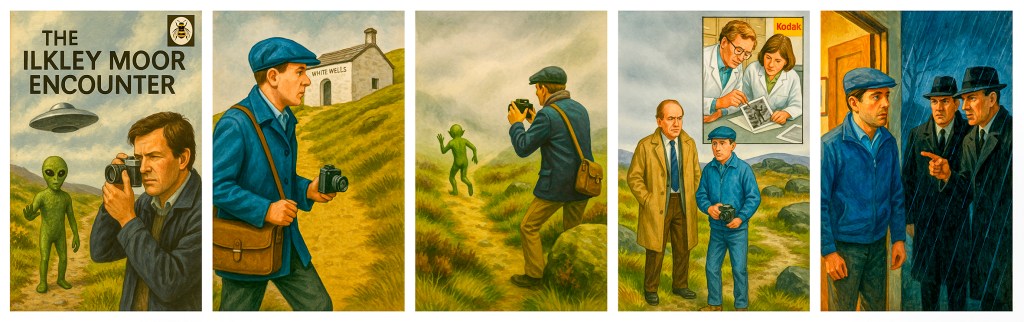
One of the most striking series, Boys Own Story, adopts the nostalgic narrative style of mid-century children’s publishing—particularly the warm, illustrative aesthetic associated with Ladybird books. In Robinson’s reinterpretation, these imagined “Honey-Bee” children’s books depict classic British UFO sightings such as Coniston, Todmorden, Ilkley Moor and Calvine. The images feel uncannily familiar: carefully staged scenes of curious boys photographing mysterious discs, police officers investigating strange lights, and newspaper reporters examining photographic evidence. By using generative AI alongside digital compositing in Adobe Photoshop, Robinson recreates a lost visual archive that never actually existed. The result is both convincing and knowingly artificial—a speculative cultural artefact that asks viewers to reconsider how collective myths are visually constructed.
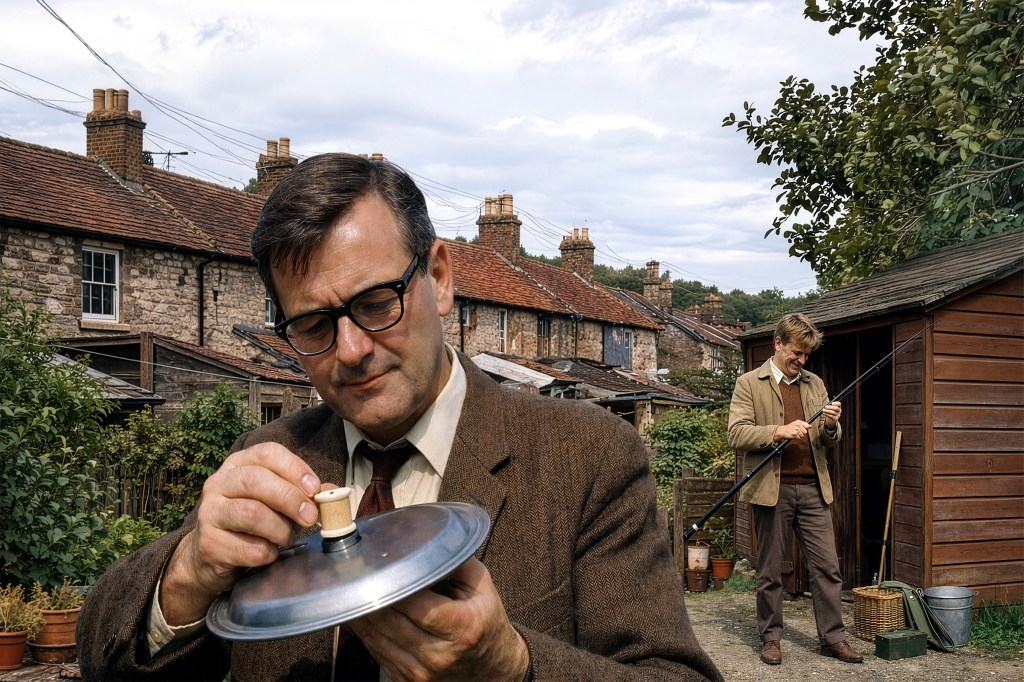
Another section of the exhibition, Flying Saucery, shifts tone from narrative to forensic reconstruction. Here Robinson references the long history of photographic hoaxes, demonstrating how simple physical tricks—cotton reels, saucepan lids, painted glass—have historically produced convincing UFO photographs. These staged illusions are recreated through photorealistic digital collage using AI-generated elements. The effect is conceptually elegant: the work acknowledges photography’s susceptibility to manipulation while simultaneously demonstrating how contemporary tools extend this lineage of visual fabrication. Rather than presenting AI as a rupture, Robinson situates it within a much longer tradition of image-making trickery.
Giclée Print on Epson Semi-Gloss Heavyweight 250g Paper, 366 x 550mm | © Andrew Robinson, 2026.
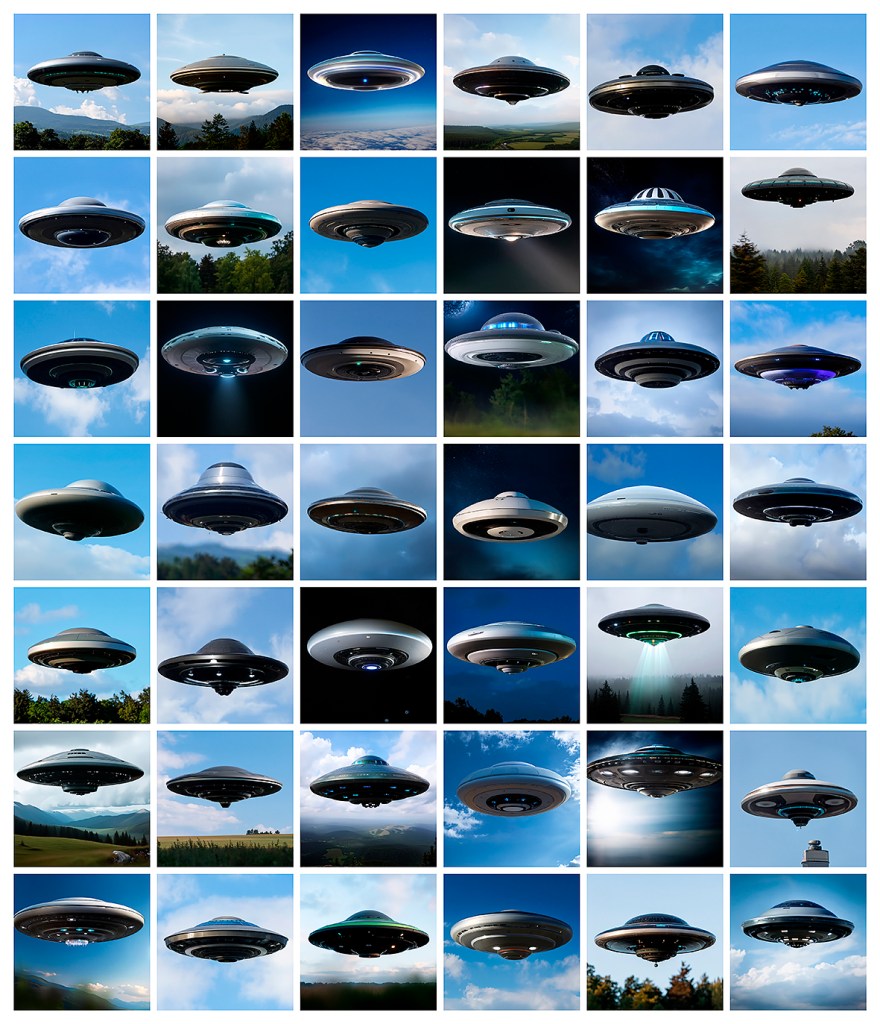
Perhaps the most conceptually intriguing work is The Answer, which presents the first forty-two images generated by Adobe Photoshop’s Generative Fill when prompted with terms such as “UFO,” “Flying Saucer,” and “Unidentified Aerial Phenomena.” What emerges is a fascinating glimpse into the “visual memory” of machine learning models. The images overwhelmingly reproduce the archetypal flying saucer: smooth metallic discs hovering against dramatic skies, emitting beams of light. Robinson’s insight is subtle but important. Even within the supposedly neutral architecture of AI systems, cultural mythology persists. The models reproduce the same iconography that dominated twentieth-century popular culture—suggesting that the folklore of UFOs has become deeply embedded within the datasets that shape contemporary AI.
This use of generative AI sits at the centre of a debate that has surrounded the exhibition itself. Some critics have objected to the presence of AI imagery within the gallery and even to its use in the exhibition poster. Their concerns broadly fall into two categories. The first relates to intellectual property and market disruption: the argument that AI tools threaten the livelihoods of photographers and illustrators by automating creative processes. The second concerns environmental impact, particularly the energy and water consumption associated with large-scale AI infrastructure and data centres.
These concerns deserve serious consideration, but Robinson’s exhibition provides a compelling counterargument through practice rather than rhetoric. Crucially, the work does not use AI as a shortcut or replacement for artistic labour. Instead, AI becomes a critical medium through which Robinson interrogates visual culture itself. The generative outputs are not presented as finished images; they are curated, manipulated, contextualised and framed within a broader photographic and historical discourse. The exhibition demonstrates that the creative value lies not in the algorithm but in the photographers conceptual framing and editorial judgement.
Indeed, the exhibition highlights something often overlooked in debates about AI and creativity: that tools do not eliminate authorship but transform it. Robinson’s role resembles that of a director, historian and editor simultaneously guiding the generative system, selecting outputs, and embedding them within narratives about photographic evidence, folklore and belief. The resulting work is intellectually coherent in a way that purely automated image generation could never achieve.
Similarly, the environmental critique, while important at the level of global infrastructure, becomes somewhat misplaced when applied to individual photographic exploration. The exhibition demonstrates how AI can be used thoughtfully and critically within photographic practice rather than as a mechanism for mass image production. Robinson’s work operates at a scale comparable to traditional digital photography and post-production workflows already commonplace within contemporary photography. The environmental cost of AI infrastructure is a systemic issue requiring regulatory and technological responses, but it should not be used to stifle exploratory creative research into the medium itself.
What makes Invasion of the Saucer Men particularly successful is its self-awareness. Robinson does not attempt to conceal the artificiality of his images. On the contrary, the work foregrounds the ambiguity between belief and fabrication that has always characterised UFO photography. By deploying AI in this context, he extends a century-long tradition of photographic experimentation and illusion. The exhibition becomes less about extraterrestrials than about the human desire to believe—and the images we create to support that desire.
In this sense, Robinson’s project feels especially appropriate within the Sheffield Creative Industries Institute, an environment dedicated to exploring emerging creative technologies. The exhibition demonstrates how AI can function as a legitimate creative medium when approached critically, historically and conceptually. Rather than replacing photography or illustration, Robinson’s work expands the field, showing how generative systems can be used to interrogate visual culture itself.
Ultimately, Invasion of the Saucer Men succeeds because it recognises that the real mystery has never been UFOs. The mystery lies in images: how they persuade us, how they deceive us, and how they shape collective myths. By combining nostalgic visual storytelling with contemporary generative tools, Robinson has produced a thoughtful and intellectually playful exhibition—one that demonstrates the creative potential of AI when placed in the hands of an intelligent being (made of meat), willing to question it.
In doing so, the exhibition makes a quietly persuasive case: that the most interesting uses of AI in the creative industries will not come from replacing human creativity, but from artists / designers / photographers who use the technology to explore the cultural systems that produced it.
Matt Edgar
11.03.26.
Further Exhibition Details HERE
 Centre For Contemporary Legend