We’re excited to share our schedule for our upcoming conference.
It’s an action packed week with a series of themed panels, a ghost walk, a banquet, and an excursion to a Plague VIllage (Eyam) and the Devil’s Arse (Peak Cavern, Castleton!). Please see below for a downloadable PDF.
Will will be sharing details of the papers being presented at each panel in the near future (see above post).
Please see below for the FINAL Schedule (correct as of 24th June).
We’re pleased to open registration for the 40th International Perspectives on Contemporary Legend Conference, held this year June 26-30, 2023 at Sheffield Hallam University, South Yorkshire, UK, and hosted by the Centre for Contemporary Legend.
There will be a series of themed panels including:
Body Horror
Social Media
Furries and Ghosts
Politics, fake news, rumour
Conspiracy & Belief
Nation & Indigienous legend
Haunted Houses
Digital Legends
Monsters
X-Files and UFOs
Crime & Moral Panics
The conference includes an optional ‘Legend and Landscape‘ excursion to the Peak District National Park, with a guided visit to the Plague VIllage of Eyam (see HERE) and a tour of Peak Cavern in Castleton (see HERE).
There will also be a conference meal at the Showroom Cinema and an evening event (watch out for further details!)
This year, ISCLR is pleased to extend members-only registration rates for members of The Folklore Society (FLS).
We have a hotel booking tool with special conference rates for two hotels in Sheffield: the Leonardo Hotel Sheffield and the Novotel Sheffield Centre. Book HERE
If you would like to join ISCLR please use this online form HERE
CALL FOR PAPERS – PERSPECTIVES ON CONTEMPORARY LEGEND
40th conference – International Society for Contemporary Legend Research
Hosted by the Centre for Contemporary Legend at Sheffield Hallam University
Sheffield, South Yorkshire, UK | 26-30 June, 2023
The International Society for Contemporary Legend Research is pleased to announce that the 2023 Perspectives on Contemporary Legend 40th International Conference will be held in the Dorothy Fleming Lecture Theatre, Charles Street building at Sheffield Hallam University,26-30 June 2023.
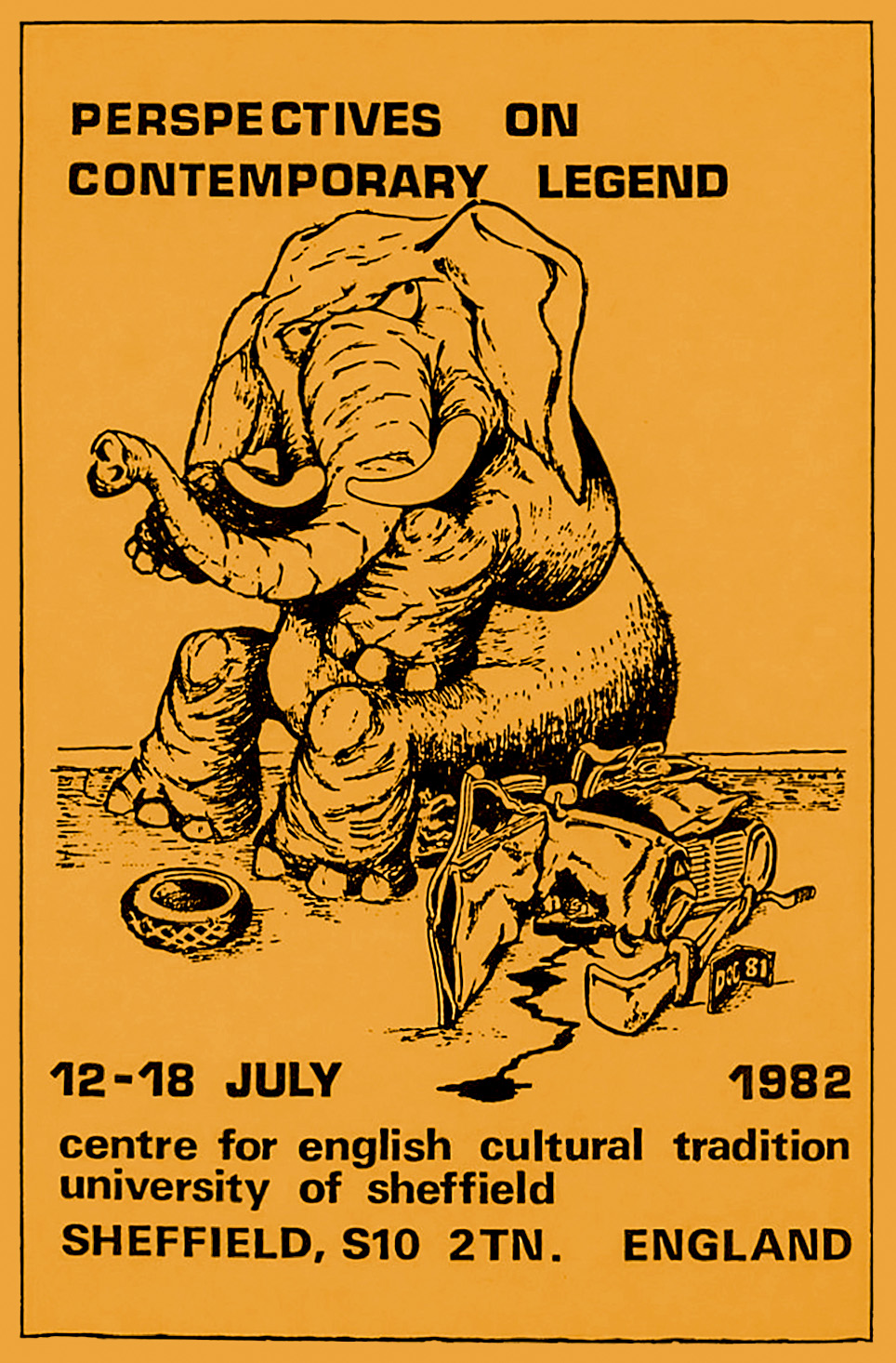
Poster designed by Doc Rowe for the first ‘Perspectives on Contemporary Legend’ conference, July 1982
The 40th conference will celebrate the return of legend scholars to the city where academic inquiry into this new genre of folklore began in the summer of 1982. Not only will we aim to celebrate that special anniversary but also to examine how contemporary legend scholarship has evolved and expanded its remit to incorporate new stories, rumors, conspiracy theories, fake and folk news in the age of pandemics and perma-crises.
SHU’s city campus is located conveniently alongside Sheffield’s Midland Railway station that has direct rail links with London St Pancras International (2 hours 10 minutes) and Manchester International Airport (approx 1 hour 30 minutes). The organisers are making arrangements for a special group rate with the Novotel on Arundel Gate, a few minutes walk from the venue and within easy reach of city centre pubs and restaurants.
The conference will be organised as a series of seminars at which most attendees will present papers. Concurrent sessions will be avoided so that all attendants can hear all papers. Presentations will be 20 minutes with an additional ten minutes for discussion. Proposals for papers on all aspects of contemporary, urban, or modern legend research are sought, as are those on any legends, traditions and stories that circulate actively at present or have circulated at an earlier historical period. Proposals for special panels, seminars and any other related areas to contemporary legend and folklore are encouraged. A few possible themes we could highlight for 2023 include:
Is the Truth still out there? Marking the 30th anniversary of The X-Files TV show
Under or mis-represented cultural communities/identities in legend studies
New legends from post-industrial urban areas
Folk Horror: Cultural and global diversity
The organisers are Centre for Contemporary Legend co-founders David Clarke, Diane Rodgers and Andrew Robinson. To submit a proposal, please forward a title and abstract (250-300 words) by February 15, 2023 by e-mail to David Clarke (david.clarke@shu.ac.uk) and Diane Rodgers (d.rodgers@shu.ac.uk).
As part of conference events, we will also be hosting film and multimedia screenings, we encourage submissions of short films or multimedia (5 -30 minutes in length) exploring, related to or influenced by Folklore, Legend or Custom as part of a curated evening of screenings – please send expressions of interest and/or links by February 15, 2023 to Andrew Robinson – (andrew.robinson@shu.ac.uk) (NB – further info will be provided shortly)
Sheffield, with a history brimming with stories and legends, is the UK’s greenest city with more trees per person than any city in Europe. Like Rome, the city is said to be built upon seven hills. One third of its area falls within the Peak District National Park, with its hills and moors forming a ‘golden frame’ around the valley of the river Don. Sheffield is world famous for its cutlery and steel industries symbolised by the statue of Vulcan, the Roman god of fire and forge, that stands on the city’s Victorian Town Hall.
Relief of Vulcan, the Roman god of fire and forge, Sheffield Town Hall – image David Clarke.
Sheffield was founded in Anglo-Saxon times as a settlement on the river Sheaf that marked the boundary between the kingdoms of Mercia and Northumbria, the ‘Sheaf-field’ or town beside the boundary river. Following the Norman Conquest, William de Lovetot built a castle at the confluence of the rivers Don and Sheaf to represent Norman power over the North of England. Sheffield Castle became one of the largest strongholds in the medieval England and in Elizabethan times it became the jail of Mary Queen of Scots. During the summer of 2023 archaeologists will begin excavating the ruins of that castle including its huge gatehouse as part of a £15 million project to regenerate the historic centre of Sheffield.
Comprehensive information on the conference will be forthcoming and will also soon be available on both HERE and on our Facebook Page. We look forward to welcoming you to this conference, the area, and the trading of our stories in our annual reunion of researchers who work on this ever current and growing legends!
For more information on the International Society for Contemporary Legend Research and to learn how to join, visit: https://contemporarylegend.org/
As a learned society long concerned with the everyday, overlooked and subtle ways that we make meaning in our lives and identities, we offer solidarity to our colleagues and friends in Ukraine at this most difficult time. The threat posed by authoritarian regimes to free speech, free thinking and liberal civil society should be a matter of bygone historical fact rather than our present reality. Any attempt to mobilise ethno-national identity as a tool of oppression and control should be vigorously and publicly rejected: we therefore affirm our support for the Ukrainian peoples and hold their plight in our hearts as events continue to unfold.
The cultural heritage of Ukraine is imperilled too. It was reported on 28 February that many works by Ukrainian artist Maria Primachenko, celebrated for her folk art style, were destroyed as the Ivankiv Museum of Local History burned down.
On 5 March, a data rescue session will take place online focused on identifying and archiving data and sites for music collections at cultural heritage institutions in Ukraine which may be at risk during the attack and invasion by Russia. Click here for more information.
Thursday, 29 October 2020, 7.00-9.30pm, online, via Zoom
Free, but prior registration is required via Eventbrite (see below)
Members of the Centre for Contemporary Legend will be presenting at an pre-halloween online event this THURSDAY 29th October entitled: Haunts – Haunted places and haunted practices
The event organised by Luke Bennett, Associate Professor in the Deptment of the Natural & Built Environment, at Sheffield Hallam University comprises of eight short presentations and is the first in an irregular series which across 2020-21 will explore new ways to investigate the relationship between places and their hauntings, through provocative and productive interdisciplinary conversations and juxtapositions.
The presentations by CCL members will be as follows:
David Clarke – The Devil’s Elbow: the genius loci of a Dark Peak landscape
Andrew Robinson – The Return of the Plague: the haunted village of Eyam
Diane A. Rodgers – Ghosts in the Machine: Haunted screens
For full details of the event and a list of all the speakers please visit Luke’s Blog HERE
About this event:
the SHU SPG is playful, and this event will be presented in that spirit
the event will be recorded and disseminated afterwards
the event will be inclusive and respectful, but is intended for an adult audience
This SHU SPG event is a co-production with SHU’s: Centre for Contemporary Legend.
For further details about SHU’s Space & Place Group or this event please email Luke Bennett: l.e.bennett@shu.ac.uk
Background image – Covid Pom-Pom display on church gate, Baildon, West Yorkshire.
Here at the Centre for Contemporary Legend at Sheffield Hallam University we have been collecting examples of responses to Covid-19 in the form of new customs, interventions and displays from scarecrows, rainbows, stone snakes and curbside gifts to communal responses such as the Belper Moo. We are also interested in how traditional calendar customs have adapted to the lockdown and the limitations imposed by the pandemic, often taking their activities online.
You can find some of the responses we’ve documented further down this blog and CCL members David Clarke and Andrew Robinson discuss their interest (along with the Belper Moo if you’ve not heard of it before!) in the Podcast they produced for the Festival of The Mind also detailed below.
We would very much like anyone who has an interesting story about ‘Covid Customs and Interventions’ they are willing to share to contribute it to our collection, along with any imagery they are happy to provide. All contributions will be fully credited (if desired) and the results shared with all contributors.
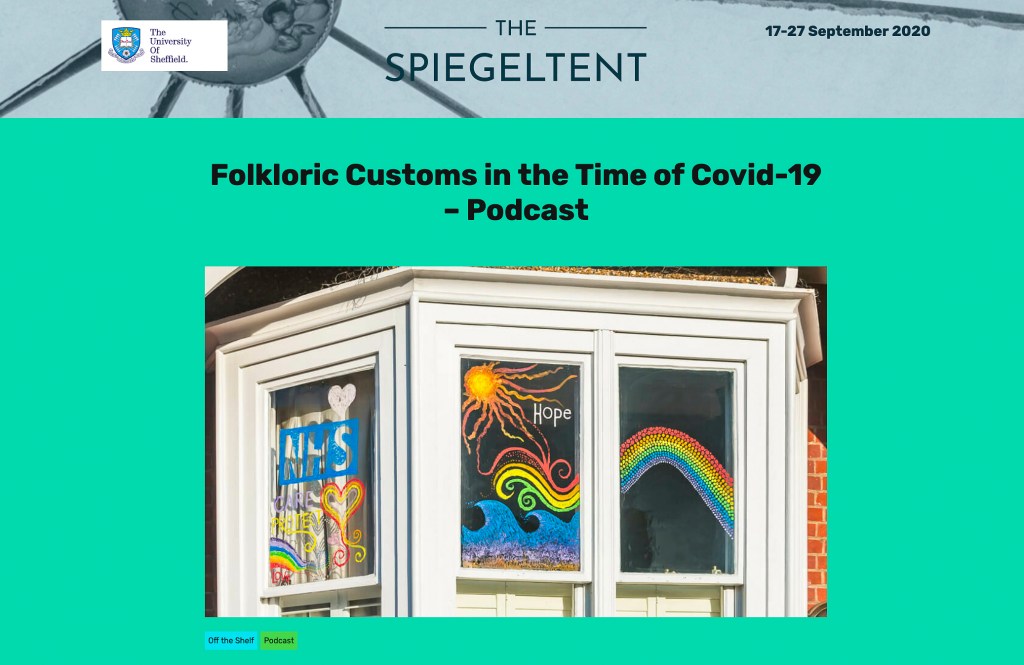
“Dr David Clarke and Andrew Robinson explore the new folkloric customs and traditions that have emerged nationally and in the Sheffield / Peak District area as an outcome of the COVID-19 lockdown.” Listen to the Podcast HERE. Part of the 2020 Festival of The Mind (see HERE) and the Off The Shelf Festival of Words (See HERE).
In this podcast Dr David Clarke and Andrew Robinson from the Centre for Contemporary Legend research group at Sheffield Hallam University discuss the new folkloric customs and traditions that have emerged nationally and in the Sheffield/Peak District area in particular, as an outcome of the COVID-19 lockdown. Whilst traditional customs such as the Castleton Garland and numerous well dressings were cancelled, others events were held online and new rituals emerged such as the weekly #ClapForCarers. Rainbow artwork decorated windows, stone snakes appeared in parks and scarecrows in a range of guises popped up in front gardens across the country. David and Andrew reflect on these and other responses to the lockdown as forms of custom and legend in this socially distanced, remotely recorded podcast.
The podcast was written and presented by Dr David Clarke and Andrew Robinson. Andrew recorded and edited the audio and provided field recordings of a number of traditional customs.
Cucklet Delph / Inside Cucklet Church / The Limestone arched entrance to Cucklet Church under pulpit rock
This year on the last Sunday in August, for the first time in many years, Cucklet Delph (top left) was empty. The Plague Sunday service that usually takes place here to commemorate the sacrifice made by the villages of Eyam during the plague of 1665-1666 was cancelled and replaced by an online service due to the 2020 Covid-19 pandemic.
During the worst days of the plague in the spring and summer of 1666 the twenty-seven-year-old village rector, William Mompesson, held outdoor services in Cucklet Delph in order to maintain social distancing amongst his flock and to try to prevent the spread of the disease. Since the bicentenary celebrations in 1866 a yearly service has been held in the Delph following a procession through the village with the Vicar preaching from the raised mound underneath which lies Cucklet Church which can be seen in the above photographs.
Online Plague Sunday Service / Mini Well Dressings Displayed on Carnival Day / Villagers leaving Eyam Hall Courtyard in Fancy Dress
Plague Sunday coincides with the village’s much older Wakes Week which begins with the blessing of the three dressed wells followed by a week of activities culminating with the town carnival the following Saturday. This year most of the celebrations were curtailed due to Covid-19. As well dressing is a communal activity it couldn’t take place as normal so in place of the large well dressings small individual designs were created and displayed in the village close to the plague cottages on Carnival Day (5th September). The carnival itself was cancelled however the Hope Valley jazz band played in a driveway opposite Eyam Hall and local people donned fancy dress and gathered at the mechanic’s institute for a socially distanced drink.
A small selection of images of Covid Scarecrows collected by Dr David Clarke during the May Bank Holiday from Stannington on the Western fringe of Sheffield.
“I was out for a walk with my wife in late May in the Loxley Valley and we climbed the hill up towards Stannington and when we reached a back road we saw what appeared to be a person sitting on the top of a high stone wall. We watched as we climbed the hill and I thought this was an unusual person as they hadn’t moved for ages. It was only when we got close I realised that this was actually quite an elaborate decorated scarecrow. Sporting a tartan hat, dark sun glasses, bright red lipstick and fluorescent pink socks, all decked off with a flower garland and a ‘Support the N.H.S.’ rainbow hanging around its neck (see the far left image above). As we walked further into the village and along the main street we saw more and more scarecrows and increasingly elaborate designs and I believe a number of them have been subsequently photographed and featured in the local paper, the Sheffield Star.“
“It’s interesting how these and other scarecrows that appeared during the original lockdown and shortly afterwards have been decorated and the themes that have been used. Alongside the omnipresent rainbows and the showing of support for N.H.S. and care sector workers there has also been the appearance of heroes and villains with Boris Johnson and Dominic Cummings masks appearing on scarecrows alongside representations of Captain Tom Moore the veteran solider who raised millions for the N.H.S. These are all interesting themes that are being played out through these local displays which seek to both provide entertainment but also personal and political commentary during Corvid.”
This commentary is taken from a Podcast entitled: Folkloric Customs in the Time of Covid-19 (available HERE) recorded by CCL’s Dr David Clarke and Andrew Robinson for the 2020 Festival of The Mind (see HERE) and the Off The Shelf Festival of Words (See HERE).
A collection of images of scarecrows on the streets of Calow, Chesterfield photographed by Andrew Rodgers during May 2020. As can be seen from the central image residents were encouraed to create scarecrows to brighten up the streets of Calow and “everyone’s daily walks”.
The majority of Scarecrows feature N.H.S. and healthcare workers of made humorous reference to the pandemic (such as the judo scarecrow preparing to fight the virus), Union Jacks and the flag of St. George were also popular motifs, probably as the festival too place close to V.E. day but also as an expression of national resilience against the virus.
Special thanks to Andrew Rodgers for contributing the photographs and for permission to reproduce them here.






 Centre For Contemporary Legend